

The birthplace of St. Francis
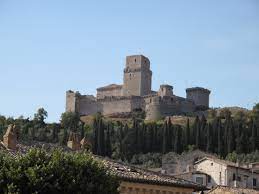
If you continue on the SS444 from Grello you reach Assisi, passing through the magnificent nature of Mount Subasio. Arriving behind the town, you can admire the superb Rocca Maggiore fortress, which was rebuilt in 1367 by Cardinal Albornoz on an earlier structure (1174) of an ancient feudal castle.
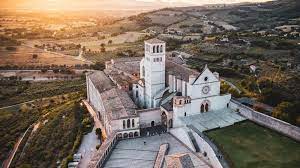
Among the many monuments that make Assisi one of the most artistically rich tourist destinations, the Basilica of St. Francis stands out, with the Saint's tomb and masterpieces by some of the greatest artists of all time such as Cimabue, Giotto, Pietro Lorenzetti and Simone Martini. Seen from afar, it looks like a single stronghold but is actually composed of two overlapping churches: the Lower and Upper Basilica and a crypt with the saint's tomb: simple, dug into the wall and circular like the Holy Sepulchre, there is the stone urn enclosed by bars in two iron grills in which the saint's body was found. Above the tomb burns a lamp with oil offered each year from a different Italian region.
The Basilica of St. Clare: One cannot understand the importance of the Basilica of St. Clare without mentioning the relationship of the saint from Assisi with St. Francis: fascinated by the preaching of St. Francis, at the age of 18 she fled her wealthy family to join Francis and the early friars at the little church of St. Mary of the Angels, already called the Portiuncula. She soon moved to the church of St. Dominic where, joined by her sisters Agnes and Beatrice and her mother, she founded the Order of the Poor Clares. Here she lived and died after 42 years. The church of St. Clare was built soon after her death, right next to the ancient church of St. George, which had held the remains of St. Francis until 1230. The saint's remains were moved as early as 1260 but the official consecration took place in 1265. The little church is in the Umbrian-Gothic style, with a three-aisle interior: behind the altar is the Oratory with the Crucifix that spoke to St. Francis in the Hermitage of San Damiano and was the basis of his choice of life. Behind a grate are some important relics of the saint and St. Francis. From the stairs, located halfway up the Basilica, there is also access to the Crypt with the Saint's body. Behind a grate are the mortal remains of St. Clare preserved in a Subasian stone sarcophagus.
The Romanesque cathedral of St. Rufino is the oldest church in Assisi and is believed to rise in the space where the ancient Roman Forum was and in the same place where there was a temple dedicated to Bona Mater (or Ceres goddess of the harvest). Built in the 12th century, it was dedicated to St. Rufinus, a 3rd-century bishop and martyr.
It is believed that St. Francis and St. Clare were baptized here. In this church, also, St. Francis made his first preaching.
The facade is considered the finest example of Gothic-Humbrian, austere, with three rose windows and three portals. The lunette houses Christ Enthroned between the sun and moon, the nursing Madonna on the left and St. Rufinus on the right.
There is also a crypt in the cathedral that houses a small museum with artifacts found in Assisi and the first sarcophagus that housed the saint's remains. More than a crypt, it is a true underground church, very fascinating and worth a visit.
On the Piazza del Comune are the Palazzo dei Priori, the 13th-century Palazzo del Capitano del Popolo with the Civic Tower and the so-called Temple of Minerva, the best-preserved Roman building in the entire region, built between 40 and 30 B.C.
Places related to the life of St. Francis can be visited in the immediate vicinity:
-
-
- The Hermitage of the Carceri, nestled in a dense forest on the slopes of Subasio, Many of the stories related to the Saint's life, such as the sermon to the Birds are believed to have taken place here. The Hermitage is a wonderful place that deserves a morning or afternoon. We are only 4 km from the center, in the heart of Mount Subasio, in a dense and silent forest. And this is precisely why religious have always sought "shelter" in this place: the very name, "Carceri," does not mean prison but comes from the Latin Carcer meaning "lonely place." Originally they were just very poor (and very cold) cells carved into the rock; then, over the centuries, the parts that we can still admire today were added. We start from the small cloister with the well of St. Francis from which, according to legend, St. Francis made water gush out. From here we enter the conventino, the original cells of the religious clinging to the rock of the mountain. It then passes the Chapel of St. Mary Magdalene and the Oratory of St. Mary where St. Francis gathered for communal prayer. You then arrive at the Hermitage's most spiritual place, the Grotto of St. Francis. On the bare, cold stone of this cell the Saint slept and prayed. A bridge connects the Hermitage to the forest where the caves where St. Francis and the Saint's other companions prayed are still visible.
- The Convent of San Damiano, is located not far from the historic center of Assisi. The church, built between the 8th and 9th centuries in honor of the medical saint Damian, was an important Benedictine priory in 1030. Later, it was gradually abandoned. St. Francis in this very place heard the voice of Christ for the first time. The Crucifix, now kept in the basilica of St. Clare, said to the saint, "Francis, go and repair my house which, as you see, is in ruins" (alluding to the crisis of the Church). The saint received strength and confirmation in his vocation from these words. The first restoration of the church of San Damiano was carried out by St. Francis himself, who welcomed St. Clare and her companions there in 1212 and composed the Canticle of the Creatures here. The Poor Clares built a small dormitory and remained at San Damiano until 1260, shortly after the death of St. Clare. The church's simple facade is preceded by a wide portico; in the upper wall is the door from which St. Clare put the Saracens to flight by displaying the monstrance. Under the portico, to the right, is the chapel of St. Jerome, where frescoes by Tiberio d'Assisi (1517) with the Madonna and Child between St. Francis, St. Clare, St. Jerome and St. Bernardine are visible. On the back wall St. Sebastian and St. Roch (1522). The interior has a single nave. Upon entering, immediately to the right, it is possible to see the small window from which Francis threw the rejected denarii for the restoration of the church. The episode is commemorated here by an unknown 14th-century painter. A little further on is the 16th-century chapel that houses a wooden Crucifix, carved by Friar Innocent of Palermo in 1637. On one side are visible two pieces of historiated glass evoking the Canticle of the Creatures. The altar of relics contains the ivory box in which St. Clare kept the Blessed Sacrament. The church's apse basin is decorated with frescoes by an unknown 14th-century Umbrian painter of St. Damian, St. Rufinus and Madonna and Child. Below, a wooden choir stalls from 1504. Above the high altar is a copy of the Crucifix that spoke to St. Francis. Adjacent to the church is the sacristy; inside, a small room was the refuge of St. Francis being chased by his father. A staircase leads to the oratory consisting of a small chamber with an apsidiole, where the infirm St. Clare stayed. The apse basin is decorated with 14th-century frescoes. To the right, a few steps lead to the dormitory; a cross marks the site of the saint's death, August 11, 1253.
- The imposing basilica of St. Mary of the Angels, built between 1569 and 1679 to protect the Portiuncula, the small church that welcomed the first community of Franciscans. The small church takes its name from "Portiuncula," which literally means the small portion of land on which it stood. This little church was one of the first three to be restored by the saint who made it the center of Franciscanism: here he has the vision in which Jesus bestows on him the Indulgence known as the "Indulgence of the Portiuncula" or "Pardon of Assisi," later approved by Pope Honorius III. At the Portiuncula he gathers his friars each year who go around the world to proclaim the Gospel. Also in the Basilica is the Chapel of the Transit, a stone room where the convent's infirmary was located, where St. Francis spent the last days of his life and died on the night of October 3 to 4, 1226. Finally, a symbolic place full of charm: the Rose Garden with roses in which St. Francis rolled to fight against doubt and temptation. According to the story, the plants in contact with the saint's body lose their thorns, giving rise to the "Rosa Canina Assisiensis," which still continues to bloom only at the Portiuncula. A visit cannot be said to be complete without entering the museum, which houses a few but extraordinary works: a panel depicting St. Francis attributed to Cimabue; the Crucifix by Giunta Pisano (1236); St. Francis and Angels by the Master of St. Francis (13th century); the Madonna of Milk, a splendid polychrome stone sculpture; and a glazed terracotta dossal by Andrea della Robbia (1475). Also in the museum is the Conventino, the cells in which the friars lived that now house contemporary sacred art exhibitions.
-
More information you can visit: https://www.visit-assisi.it/