

Norcia in the Sibillini Mountains was born in San Benedetto. Famous for its monuments and food specialties (salami and mushrooms, in particular).
Ancient city of the Sabines, Nursia was conquered by the Romans and became an important town hall. A free commune in the 11th century, in the 15th century it passed definitively to the Church, which granted it considerable autonomy. Around 480 Saint Benedict was born there. Several times destroyed over the centuries by various earthquakes, it preserves a remarkable heritage of art and historical memories related to the life of the founder of the Benedictine order.

ART, CULTURE, ENVIRONMENT
Divided into districts (yelps) and with an urban fabric of the eighteenth-nineteenth century, Norcia boasts a large historical and artistic heritage that places it among the most important art cities of Umbria.
On the main square overlook the most important and ancient historical buildings of the city: around the statue dedicated to San Benedetto, frame the Castellina, a monumental fortress built in 1554 to a design by Vignola, now home to the Civic and Diocesan Museum, the Town Hall, with double loggia, the Basilica of San Benedetto, erected on Roman ruins of the first century, with Gothic facade of the fourteenth century, in whose crypt are preserved the remains of an ancient Roman building identified by tradition with the paternal home of the twin Saints Benedict and Scholastica, the portico of Measures, built around the middle of the sixteenth century as a covered market of cereals. The Concattedrale of Santa Maria Argentea, dating from the 16th century, with an altar by Duquesnoy (1640) is slightly set apart from the square.
To see the complex of San Francesco, the fourteenth century, now home to the Auditorium, the Municipal Library and the Historical Archives, the Palace of the Knights of Malta, now home to the Museum of Peasant Art, and the church of Sant'Agostino, built in the fourteenth century.
Very interesting are the Tempietto, the most original and best preserved historical building of Norcia, made in 1354 by the nursino Vanni della Tuccia, the church of San Giovanni, one of the oldest in Norcia, which preserves a beautiful wooden ceiling and the Renaissance altar of 1649, the oratory of Sant'Agostinuccio, with an elegant wooden ceiling and a precious baroque altar, the church of the Madonna Addolorata, which houses the miraculous image of the Madonna depicted on a canvas painted in the eighteenth century, the church of the Crucifix, right behind the city walls, in the upper part of the city, and the church of San Lorenzo, the oldest of Norcia.
Norcia is in the heart of the Monti Sibillini National Park: the city is surrounded by mountains that reach over 2000 meters high, a paradise for hikers and skiers. Among the mountains, in large flat amphitheaters, they produce valuable crops (famous lentils of the plain of Castelluccio) and breed large quantities and varieties of animals (pigs for the production of the valuable cold cuts of pork).
A short distance from the city, in the wide floors of Castelluccio, there is the European school of free flight, while in the many paths throughout the National Park there are hiking, horseback riding and even mule trekking; The waterways of Sordo and Corno offer the opportunity to practice rafting and canyoning, while the picturesque rocky walls, karst caves and gorges that characterize the entire territory of Valnerina are the ideal place for free-climbing and caving.
Nearby are worth a visit Forca Canapine (20 km from Norcia, 1541 meters), tourist center equipped for winter sports and hiking, the Plans of Castelluccio (Pian Perduto, Piano Piccolo and Piano Grande, vast karst basin, characterized in spring by a splendid alpine flowering), Monte Porche (2235 meters), with impressive views of the Sibillini Mountains and the Abruzzo Mountains, Mount Vettore (2476 meters)with the lake of Pilato and the cave of the Sibilla, and the necropolis of the plain of Santa Scolastica, with finds from the Iron Age to the Roman era.
Norcia was affected by the earthquake that struck Central Italy in 2016 and that damaged some of the most important treasures of its artistic and cultural heritage.
Among these, the church of San Benedetto, which after the strong tremors followed, collapsed completely, preserving intact only the outer facade.
Today, thanks to various interventions in support of the city and the surrounding hamlets, Norcia is taking the first steps towards reconstruction, which will see the birth of a new urban furniture in line with the historical and cultural face of the city of San Benedetto.
The Flowering of Castelluccio di Norcia
Every year Il Pian Grande di Castelluccio di Norcia comes alive with a spectacle of nature among the largest in the world.
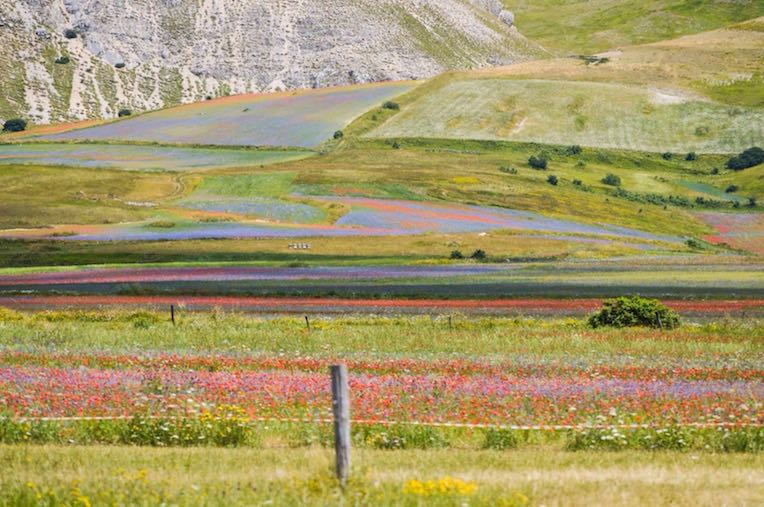
Between the beginning of June and the end of July, you can live an unforgettable multisensory experience: poppies, cornflowers, daisies, violets, lentils, daffodils, gentians and many other spontaneous species create a wonderful mosaic of colorful beauty and intoxicating scents. The small and delicate white flower with light purple shades is the protagonist of this charm: the lentil. Called by the inhabitants of Castelluccio 'Lénta'' is the representative product of the country par excellence. Farmers in the area, to preserve the fields and not use pesticides for cultivation, have always allowed other plants to thrive in the land, drawing many benefits. It is in this way that, waiting for the growth of lentils, spontaneous plants are renewed, bloom, creating a unique floral show in the world.
| When to go: |
Unfortunately, you can only make a general forecast of the time of flowering, it all depends on the weather trend of the season. Snow, Rain, temperature and sun are the true architects of the calendar and only for a few weeks you can appreciate and enjoy the beauty of flowering that every year produces unique and unrepeatable shades and colored backgrounds. Flowering is now a much loved natural and cultural event; to live it to the fullest, we recommend choosing the midweek days, avoiding the weekend |
| How to go: |
If you can not give up your own vehicle, park in the marked areas, avoid going to the center of the country, and then walk to the flowering, will be a unique experience. You can also rent electric bikes by calling +39 393 2096641. The e-bike service will deliver the bikes to your desired location. Also you can rent horses and mules with guide. Your car can be left in one of the many parking spaces nearby with prior reservation through the portal http://www.parchiaperti.it/. Castelluccio will then be reached on foot, by bike or through the shuttle service from Norcia with four daily trips A/ R, active on Saturdays and holidays. For information and timetables, visit: www.fsbusitalia.it |
| What to do: |
In respect of nature and its exceptional nature, to immortalize the beautiful blooms, try to stay along the nearby paths, avoiding to enter the cultivated fields not to step on the flowers. The plateau of Castelluccio opens the doors to unique places where you can do an incredible number of activities: hiking, mule trekking, mountain biking, bird-watching, rufting, deltapiano and paragliding. |
The guides, highly trained, can accompany you to discover these unparalleled places, to immerse yourself in the tranquility and wonder of the Sibillini Mountains.
For more information: https://www.castellucciodinorcia.it/