

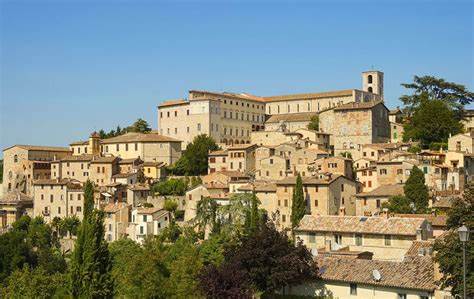
Even described as the 'ideal city to live in': perched on rolling hills, with a strategic location and breathtaking views, Todi catapults us straight into a history lesson, with its Roman cisterns, Etruscan remains and medieval palazzi.
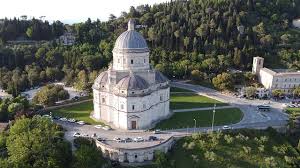
Not to be missed are the underground Todi, the Sanctuary of Merciful Love, Piazza del Popolo, the Cathedral of the Santissima Annunziata, the Temple of Santa Maria della Consolazione, the churches of San Fortunato and Nunziatina, and the Palazzo del Capitano del Popolo.
The beating heart of Todi and a compulsory starting point for a visit is Piazza del Popolo, overlooked by the town's main buildings such as the Palazzo del Popolo, the Palazzo del Capitano, the Palazzo dei Priori and the Cathedral of the Annunziata.
The Palazzo del Popolo is one of the oldest buildings in Italy: in fact, its construction dates back to the 13th century in the Lombard-Gothic style, and an elegant external staircase connects it to the adjacent Palazzo del Capitano, which houses, together with the Palazzo del Popolo, the seat of the Todi Municipality and the Museo Civico, which houses antiquities and finds from Etruscan, Roman and medieval times, such as sculptures, ceramics and coins, as well as the museum's showpiece, Anita Garibaldi's saddle.
The Palazzo dei Priori, which stands on the other side of the square opposite the cathedral, has an austere profile that hints at its medieval origin. The building and the trapezoidal tower were built between 1334 and 1347, while the window decoration on the façade was added in the 16th century. It is currently the seat of the Magistrate's Court and other municipal offices, but it is possible to visit the Halls of Hearings, frescoed in the 14th century.
 |
 |
 |
 |
The Cathedral of the Santissima Annunziata, in Romanesque-Lombard style, is said to have been built on the ruins of a temple dedicated to the god Apollo: in fact, the original construction dates back to the 12th century, although it has been modified and renovated several times since the 15th century. On the outside, the Cathedral of the Annunziata is distinguished by its bell tower and monumental staircase. From the top of the bell tower, one can even see as far as Perugia, a beautiful city - the regional capital - about 50 km from Todi.
For some years now, the Monastery of St. John the Baptist, also known as the Monastery of the Lucrezie, has housed the Lapidary Museum of the city of Todi, which presents one of the most important and oldest collections in the whole of Umbria, bearing witness to the thousand-year history of Todi and its territory with stone artefacts from the Roman, as well as medieval and Renaissance periods.
Underground Todi: an incredible route of more than 5 kilometres winds beneath the town of Todi, allowing visitors to admire more than 30 Roman, pre-Roman and mediaeval cisterns, passing through tunnels and galleries: the two Roman cisterns below Piazza del Popolo are more than 80 metres long. You can descend into underground Todi by booking a guided tour.
Palazzo Pongelli-Benedettoni: for all those interested in the history of Todi, and of its most illustrious citizen, the poet Jacopone da Todi, a visit to Palazzo Pongelli-Benedettoni, a splendid 16th-century palace entirely covered in frescoes, which, according to tradition, was Jacopone's residence after his marriage, is a must. Reservations are required to visit it.
The Parco Fluviale del Tevere (Tiber River Park): if it is total immersion in nature, you are looking for in Umbria, you are in luck: along about 50 kilometres of the course of the Tiber River, there is the Parco Fluviale (River Park), which runs through the territories of Todi and Orvieto. Besides being an area rich in wild flora and fauna, it is also a true open-air archaeological area.
The Rocca di Todi: on the hill at the highest point of Todi is the Rocca, built in 1373 and commissioned by Pope Gregory XI. Today, from the fortress, more than four hundred metres above sea level, one can enjoy a beautiful panorama, and walk in the surrounding park.
For information, please visit: https://www.visitodi.eu/it/